Campaign for Grade-Level Reading
LEO Team
“People are no longer satisfied passively receiving what’s been prescribed for them. They have the right and the responsibility to pursue education that fits with their lives, that fits with their values, and they are going after it. They are pursuing it.”
Meredith Olson, CEO, VELA
In recent years and accelerated by the pandemic, parents are increasingly curating their children’s K–12 educational experience. This curation involves choosing among a larger and more diverse array of options, from homeschooling to microschools, virtual charters, and more. In doing so, these parents are bringing into the K–12 arena many of the same behaviors and expectations they have for the mixed-delivery child care and pre-K options they encounter before formal school is mandated and for the market of postsecondary options they pursue with and on behalf of their children — college, careers, military service. The Campaign for Grade-Level Reading’s five-part GLR Learning Tuesdays series sought to explore the promise, potential, and possible pitfalls of this emergent trend.
Across the sessions, panelists explored the opportunities of this increased parental curating — including choice, innovation, flexibility, and personalization — as well as implications for equity, access, and accountability that parents, policymakers, and education leaders should heed. Panelists shared research and insights on education options experiencing growth, including open enrollment (both within one’s district and across districts), homeschooling, and microschools. They discussed the necessity of parent awareness and agency to take advantage of these increased options, and the need for quality choices. In the final session on the new federal education tax credit, panelists shared how this new tax credit, which could become the largest federal investment in education, holds potential to increase opportunities and resources for students furthest from opportunity. They also expressed concern regarding issues of access and sustaining federal investments in K–12 education, including Title I, that continue to be critical to support students from economically challenged families.
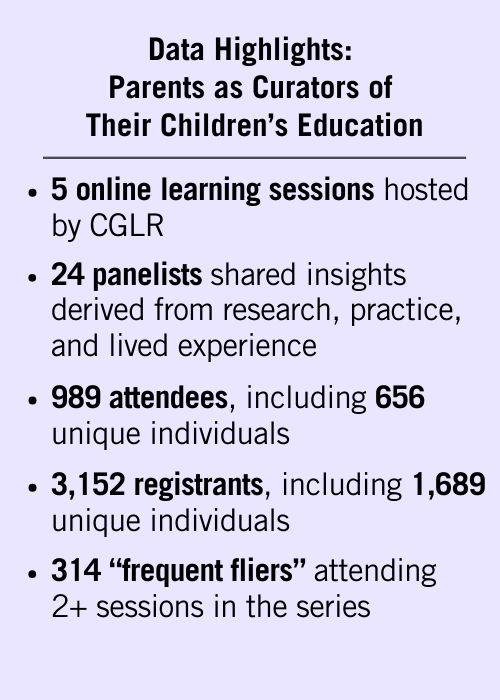
Themes that emerged across the sessions included ensuring quality choices, not just more choice; lessons and innovations that public schools can learn from alternative education options, including from homeschooling and microschools; the role and design of research to inform and assess the impact of various educational options; considerations for the policy design of increased educational choice to incorporate equity, access, and opportunity; and the need and opportunity for school districts to respond to this increased parental curation through greater choice and voice for parents to shape their children’s education.
“How can you play with creative staffing models, the use of emerging technologies to be able to customize education in more effective ways? How can you really listen to both parents and teachers about what they’re lacking in their current experience and be able to think about creative approaches to be able to respond to those needs?”
–Robin Lake, Director, Center on Reinventing Public Education
“Homeschool or public school, all students learn better when they are respected, and valued and heard.”
– Webinar attendee from the Parents as Curators series
The Parents as Curators sessions included:
- Parents as Curators of Their Children’s Education: Balancing Choice, Equity, and Accountability. The series launched during GLR Week 2025 with a session in which panelists discussed the overall growth and trends of increased parental curation in K–12 education, including through open enrollment, and explored both opportunities as well as concerns that increased curation brings, particularly in relation to issues of equity and accountability.
- Supporting Parent Agency and Informed Decisions. Featuring leaders from national and local nonprofit organizations focused on parent leadership, choice, and advocacy, this session explored why it is important to help parents make informed decisions in this more complex educational landscape of increased choice, and panelists shared how their organizations are helping parents navigate these options at the local level through information and supports so parents can select the best K–12 education options for their children.
- Homeschooling as Anchor, Catalyst, and Precursor? This session featured a panel of researchers and homeschool practitioners who discussed the evolution of homeschooling to become more diverse and dynamic today, and why and how parents are pursuing homeschooling as an increasingly attractive alternative to their local public schools.
- The Growth and Potential of Microschools. This session engaged national microschool nonprofit leaders, a researcher, and microschool founders in a discussion about the growth and characteristics of microschools and what they look like in practice, as well as opportunities and challenges for the future of microschools, including factors of funding, innovation, and access.
- Opportunities & Implications of a New Federal Education Tax Credit. The series culminated in a session in early December that featured policy, think tank, and thought leaders who discussed the opportunities and implications of the new federal scholarship tax credit from the One Big Beautiful Bill Act, and how people can get involved as it moves through federal regulations into state-level decisions.
“Not all choices are worth choosing and not all parents have access to good choices. And that’s where this is going to get really tricky. Yes, parents want choice — 86% of American families want more public school choice options. But they’ve got to provide meaningful, measurable results.”
–Keri Rodrigues, President, National Parents Union