Campaign for Grade-Level Reading
LEO Team
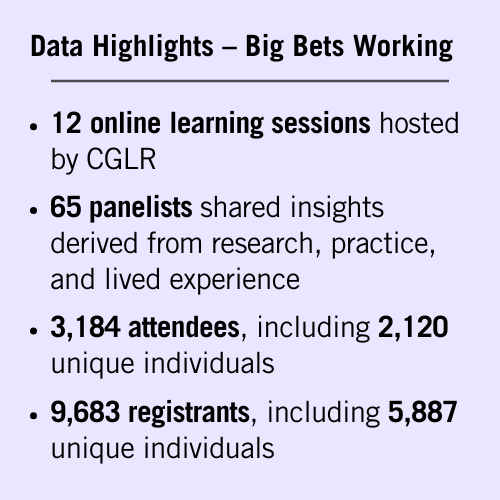
Despite significant public and philanthropic investment in education in the wake of the pandemic national data collected over the past few years reveals the sobering realities of the magnitude and longer-term implications of pandemic-precipitated learning loss. Having identified a number of “big bet worthy” programs that hold promise for accelerating equitable learning recovery and recognizing that national data can mask many bright spots where states and localities are seeing more than the usual increments of progress, the Campaign for Grade-Level Reading (CGLR) launched an ongoing webinar series, Big Bets Working, in January 2024. Over the course of 12 sessions, the series engaged a diverse faculty comprised of 65 educators, researchers, parents, and community leaders who discussed where and how some of those “big bet worthy” approaches are moving the needle for children in economically challenged, fragile, or marginalized families.
Sessions on high-impact tutoring, teacher professional development, out-of-school-time learning, family engagement, technology-enhanced teaching and learning, attendance, and digital connectivity have shown that strong implementation requires deliberate recruitment, training, data-driven approaches, and sustained collaboration between schools, districts, and community organizations. Panelists emphasized that when these elements are combined, students experience meaningful gains, foundational skill growth, and overall academic recovery. As we acknowledged the success of smart investments in these big bets, panelists also noted that some efforts have fallen short of expectations and reached fewer children and families than intended, contributing to the concerning national trends and leading to deeper exploration of opportunities and barriers to the replication and scaling of effective efforts while maintaining quality and fidelity.
The series’ focus on effective implementation and scaling efforts continues into 2025, with a recent session exploring the current landscape of high-impact tutoring. National, state, and district leaders shared effective, research-informed strategies and insights on policies, tools, and practices that ensure program fidelity and student success.
Across all Big Bets Working sessions, major themes emerged around the critical role of partnerships, relationships, and intentional supports in accelerating equitable learning recovery. Panelists highlighted efforts to connect families to essential resources such as reliable internet through community-based programs, ensuring students could access digital learning. They also demonstrated how engaging families as active partners — through home visits, parent ambassador programs, trust-building, and recognition of parents’ knowledge — positively impacted student outcomes. Strategies to improve attendance, support early learning, and maximize summer programs
reinforced the importance of consistent, targeted engagement that addresses both academic and non-academic barriers to learning, from transportation and scheduling challenges to family capacity and mindset shifts.
Collectively, these sessions reinforce the idea that equitable progress is achievable when states and districts make smart investments and when communities take coordinated, evidence-based, and relationship-centered approaches to teaching, learning, and family engagement.
“High-impact tutoring is relationship-based because relationships drive student engagement and motivation.”
–Susanna Loeb, Ph.D., National Student Support Accelerator, Stanford University
The Big Bets Working sessions included:
- Connecting Communities: National and Local Partners Linking Families to the Internet: Leaders working at the national and local level shared the steps they took to close the digital divide by expanding internet access through programs like the Affordable Connectivity Program (ACP), training Digital Navigators, and implementing creative community solutions to bring affordable, reliable connectivity to families.
- Keeping the Commitment to Tutoring Alive and Strong: Leading researchers, policy advocates, and national tutoring program providers highlighted how high-impact tutoring grounded in strong relationships, effective training, and school partnerships has accelerated equitable learning recovery. They also discussed strategies to sustain effective tutoring beyond the expiration of ESSER funds.
- Engaging Families for Everyday Attendance: Hosted in partnership with Attendance Works, this session engaged practitioners working at the school, district, community, and state levels in a discussion about how they improved student attendance by partnering with families, shifting from punitive to positive approaches, and building trusting relationships that help overcome barriers such as transportation, scheduling, and child care.
- How Summer Learning’s Resurgence and Maximization Is Accelerating In-School Learning: Hosted in partnership with the National Summer Learning Association (NSLA), this session engaged the state chief in Alabama and district leaders in a discussion about how renewed investments in summer learning are accelerating equitable academic recovery.
- Not Without Teachers: Intentional Teacher Development for Improved Student Outcomes: In this session, national teacher training and support programs joined with state and local education leaders to showcase how intentional, literacy-focused, evidence-based teacher development has strengthened instructional practice and improved student outcomes, demonstrating that large-scale progress is achievable.
- Expanded Learning = Expanded Recovery: How Afterschool Programs Drive Student Progress: Panelists, representing national programs and state and local efforts, discussed how afterschool programs are driving learning recovery by combining academic support with relationship-building, data-driven partnerships, and engaging enrichment activities that help students feel supported.
- Implementation, Replication, Fidelity: How to REALLY Scale High-Impact Tutoring: In this session, panelists examined what it takes to scale high-impact tutoring, highlighting the importance of strong school partnerships, effective tutor recruitment and training, data-driven implementation, and the central role of relationships in achieving meaningful student outcomes.
- EdTech Working: Enhancing Teaching & Learning AND Scaling Needed Interventions: In partnership with Digital Promise, this session highlighted how technology is enhancing teaching and learning by expanding access to effective interventions, promoting digital equity, and enabling the replication of evidence-based models.
- Not Just Nice But Necessary: Family Engagement = A Big Bet That’s Paying Off for Kids: Leaders of national, state, and local programs highlighted how family engagement strategies such as home visits, text messaging, parent ambassador programs, and community partnerships drove measurable improvements in student outcomes.
- Beyond Parent-Teacher Conferences: Partnerships That Maximize Student Learning: In this session, state and national family engagement leaders joined with district leaders to discuss strategies for building trust, recognizing parents’ knowledge, and supporting teachers in creating strong partnerships with parents.
- Starting School With Success: How Summer Learning Closes Gaps in the Early Years: Hosted in partnership with NSLA, this session highlighted how summer learning programs support academic recovery, strengthen foundational skills, and engage families to help young children start school ready for success.
- Implementation & Sustainability: What Makes High-Impact Tutoring Work: Continuing CGLR’s focus on high-impact tutoring as a key strategy for learning recovery, this session examined challenges of implementation such as recruiting tutors, scheduling, and aligning with classroom instruction. Panelists representing national tutoring efforts and states and districts shared insights on policies, tools, and practices that ensure program fidelity and student success.
“Like any relationship that we can think of, the strongest are grounded in trust and teamwork.
Same applies for parents and school-based leaders, teams, and educators.
Family engagement strategies need to be anchored in student learning and student well-being.”–Shana McIver, Learning Heroes